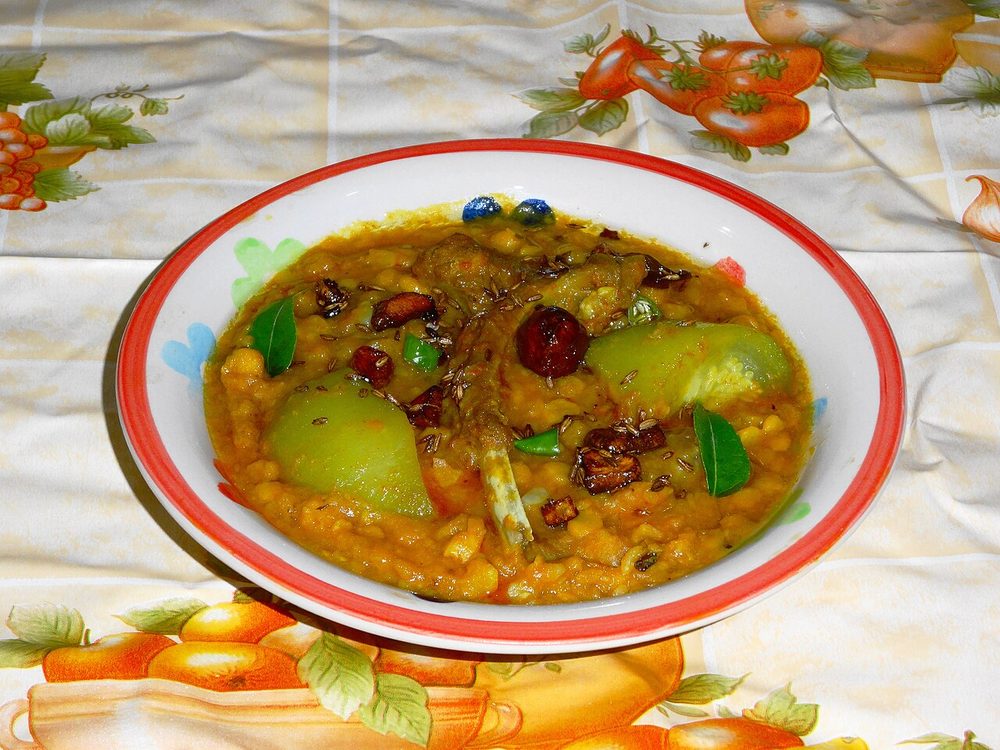
Allergens in Dalcha: mustard.
Ingredients
Quantities for 6.
- 500g, bone-in pieces Muttonneck and rib pieces give the best body
- 200g, rinsed Chana Dal
- 300g, peeled and cut into 3cm chunks Bottle Gourd
- 2 medium, sliced Onion
- 2, chopped Tomato
- 40g pulp, soaked in 200ml hot water Tamarind
- 1 tbsp, paste Ginger
- 1 tbsp, paste Garlic
- 4, slit Green Chilli
- 1 tsp Turmeric
- 1.5 tsp Chilli Powder
- 2 tsp Coriander Powder
- 1 tsp Garam Masala
- 2 sprigs Curry Leaves
- 1 tsp Cumin Seeds
- 1 tsp Mustard Seeds
- 3, broken Dried Red Chilli
- 4 tbsp Neutral Oil
- 1.2 litres Water
- to taste Salt
- 3 tbsp, chopped Coriander Leavesoptional
Cookware
stovetop, pressure cooker
Checked against the ingredient list for ten allergens: milk, egg, fish, crustaceans, tree nuts, peanuts, sesame, mustard, soy and gluten. Brands vary, so read the label on anything new to you.
Before you start
- Soak the chana dal for 30 minutes so it cooks at roughly the same rate as the mutton.
- Soak the tamarind in hot water for 20 minutes, then squeeze and strain. Dalcha is defined by its sourness, so do not skimp.
- Cut the bottle gourd last; it goes in late and should not sit and weep.
Method
- Heat 2 tbsp oil in the pressure cooker and brown the sliced onion for 8 minutes until golden at the edges.
- Add the ginger and garlic pastes and fry 1 minute, then the mutton. Sear on high for 5 minutes until the pieces lose their raw pink.Sear in one layer; crowded meat steams and stays grey.
- Stir in the turmeric, chilli powder, coriander powder and salt, add the tomatoes, and cook 5 minutes until the tomatoes break down.
- Add the drained chana dal and 1 litre of water. Pressure cook 4 whistles, about 20 minutes, then let the pressure drop naturally.Natural release keeps the mutton tender; a forced release toughens it.
- Open, add the bottle gourd and the remaining water, and simmer uncovered 12 minutes until the gourd is translucent and yields to a spoon.
- Pour in the tamarind water and the garam masala. Simmer 10 minutes more, mashing some of the dal against the side of the pot to thicken it.Add tamarind only after the dal is soft. Acid early keeps pulses hard.
- Taste for salt and sour; the balance should make you sit up. Adjust with a little more tamarind water or a splash of plain water.
- For the tempering, heat the remaining 2 tbsp oil in a small pan and crackle the mustard and cumin seeds, then add the dried red chillies and curry leaves and let them spit for 10 seconds.
- Pour the tempering over the dalcha, stir once, and scatter with coriander leaves. Rest 5 minutes before serving with bagara rice.
Safe temperatures: Whole cuts of mutton, beef and pork are done at 63°C / 145°F, rested 3 minutes. A long braise passes that well before the meat is tender. Reheat leftovers to 74°C / 165°F. FoodSafety.gov
Storage
Keeps 3 days refrigerated. It thickens considerably as it sits; loosen with hot water when reheating over low heat, and check the salt again after.
Nutrition Good estimate
One serving of Dalcha (451 g) is about 362 calories, or 81 calories per 100 g.
High protein: 26 g a serving, 29% of the calories
| Per serving451 g | Per 100 g | |
|---|---|---|
| Calories | 362 kcal | 81 kcal |
| Protein | 26.2 g | 6 g |
| Carbohydrate | 35.3 g | 8 g |
| of which sugars | 9.2 g | 2 g |
| Fibre | 7.0 g | 2 g |
| Fat | 13.8 g | 3 g |
| of which saturated | 1.8 g | 0 g |
| of which unsaturated | 10.7 g | 2 g |
Nearest database match used for curry leaves, garam masala, mutton. Estimated from raw ingredients using USDA FoodData Central.
More like this: Healthy Indian recipes · Gluten-free Indian recipes · Dairy-free Indian recipes · Hyderabadi recipes
Times, yields, allergens and nutrition are guidance. Use your own judgement on doneness and on storing. More in About.