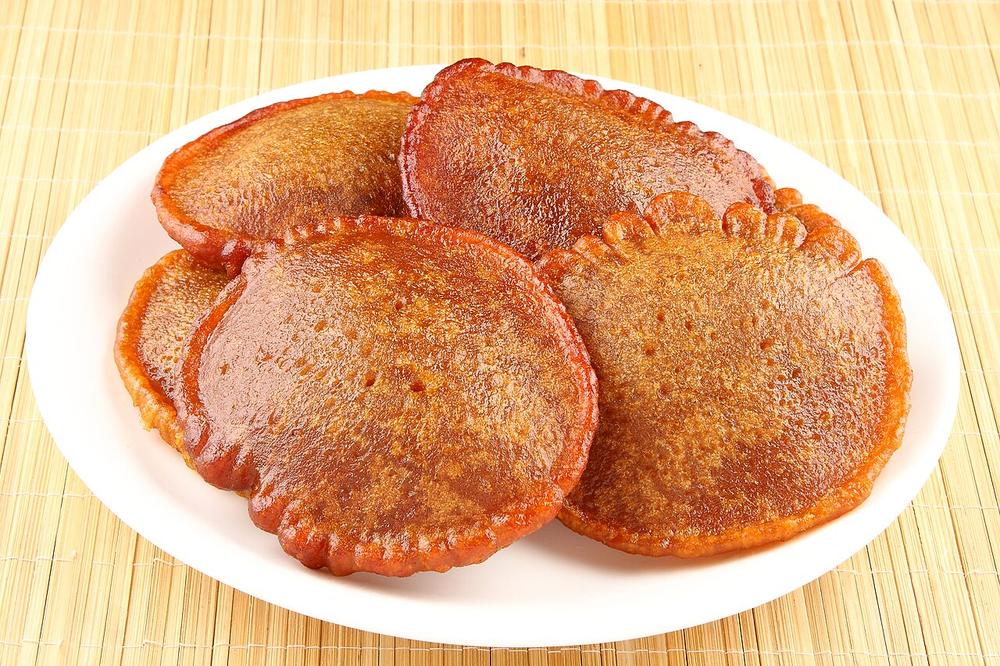
Start the day before. The soaking alone is 4 hr, against 55 min of actual work.
Allergens in Neyyappam: milk, sesame.
Ingredients
Quantities for 6.
- 250g, raw, soaked 4 hours Riceany short or medium grain works
- 225g, grated Jaggery
- 1/2 cup, cut into small thin slivers Coconutfried in ghee first, then folded through
- 5 pods, seeds crushed Cardamom
- 1/2 tsp Dry Ginger Powdertraditional, and it stops the sweetness cloying
- 1 tsp Sesameoptional
- 300ml for frying, plus 2 tbsp Gheeghee is what makes it neyyappam; oil gives a lesser thing
- 1/8 tsp Baking Sodafor lift, added at the last momentoptional
- 150ml Water
- 1/4 tsp Salt
Cookware
stovetop, kadhai, blender
Checked against the ingredient list for ten allergens: milk, egg, fish, crustaceans, tree nuts, peanuts, sesame, mustard, soy and gluten. Brands vary, so read the label on anything new to you.
Before you start
- Soak the rice at least 4 hours, or overnight, then drain it thoroughly in a sieve for 15 minutes.
- Make the batter and rest it 2-3 hours before frying. Unrested batter fries flat and heavy.
- You need an appakara or aebleskiver pan for the classic shape; otherwise fry spoonfuls as small round fritters in a deep kadhai.
Method
- Melt the jaggery with 100ml water over medium heat until dissolved, about 5 minutes, then strain through a sieve and cool to lukewarm.Cool the syrup before it meets the rice. Hot syrup part-cooks the batter and it will never rise.
- Grind the drained rice with the cooled jaggery syrup and the remaining 50ml water to a thick, smooth batter. Thicker than dosa batter, roughly the consistency of cake batter.
- Beat in the crushed cardamom, dry ginger powder and salt, then cover and rest the batter 2-3 hours at room temperature.
- Heat 2 tbsp ghee in a small pan and fry the coconut slivers for 3-4 minutes until golden at the edges, then fry the sesame for 20 seconds.
- Fold the fried coconut, sesame and all the ghee from that pan into the rested batter.
- Stir in the baking soda if using, right before frying, and do not let the batter sit after this.
- Heat the remaining ghee in a kadhai over medium heat until a drop of batter rises to the surface within 3 seconds without browning instantly.Too hot and the outside darkens while the centre stays raw batter. Medium heat, patiently.
- Drop in tablespoons of batter, 4-5 at a time, and fry 3 minutes until the undersides are deep mahogany.
- Flip each one and fry a further 2-3 minutes until puffed, dark and firm at the edges.Test one first. If it collapses on flipping, the batter is too thin. Beat in a tablespoon of rice flour before continuing.
- Lift onto a rack to drain and cool, and let the ghee come back to temperature between batches.
- Serve at room temperature, when the outside has crisped and the inside stays soft.
Storage
Keeps a week in an airtight tin at room temperature and up to 3 weeks refrigerated. No reheating needed. Bring back to room temperature before eating.
Nutrition Good estimate
One serving of Neyyappam (119 g) is about 384 calories, or 323 calories per 100 g.
Low protein: 3 g a serving, 3% of the calories
| Per serving119 g | Per 100 g | |
|---|---|---|
| Calories | 384 kcal | 323 kcal |
| Protein | 3.2 g | 3 g |
| Carbohydrate | 71.9 g | 60 g |
| of which sugars | 37.8 g | 32 g |
| Fibre | 0.7 g | 1 g |
| Fat | 9.7 g | 8 g |
| of which saturated | 6.3 g | 5 g |
| of which unsaturated | 2.8 g | 2 g |
Nearest database match used for jaggery. Estimated from raw ingredients using USDA FoodData Central.
More like this: Vegetarian Indian recipes · Gluten-free Indian recipes · No onion no garlic recipes · Kerala recipes
Times, yields, allergens and nutrition are guidance. Use your own judgement on doneness and on storing. More in About.