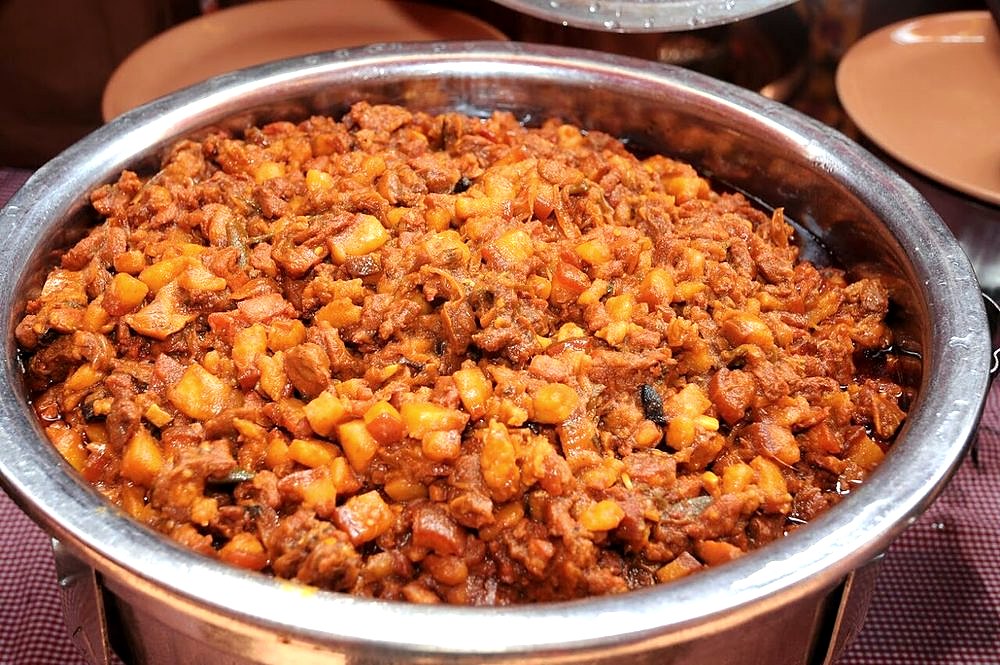
Allergens in Pork Bafat: mustard.
Ingredients
Quantities for 6.
- 1kg belly and shoulder with the fat on, cut into 2 inch cubes Porklean pork makes a thin, disappointing bafat
- 15 dried, stems snapped off Kashmiri Chilli
- 4 hot ones Dried Red Chilli
- 2 tbsp Coriander Powder
- 1 tsp Cumin Seeds
- 1 tsp Black Pepper
- 8 Cloves
- 2 inch stick Cinnamon
- 1/2 tsp Mustard Seeds
- 1 tsp Turmeric
- 12 cloves Garlic
- 1 1/2 inch piece Ginger
- 3 large, finely sliced Onion
- 4 tbsp Vinegarcoconut or palm vinegar is what is used at home
- 3 medium, quartered Potatothey soak up the fat and stretch the dishoptional
- 2 tbsp Neutral Oil
- 2 cups Water
- to taste Salt
Cookware
stovetop, pressure cooker, blender
Checked against the ingredient list for ten allergens: milk, egg, fish, crustaceans, tree nuts, peanuts, sesame, mustard, soy and gluten. Brands vary, so read the label on anything new to you.
Before you start
- Grind the bafat powder a day ahead if you can. Dry-roasted and jarred, it keeps for months and is the shortcut every Mangalorean Catholic kitchen relies on.
- Rub the pork with 1 tbsp of the vinegar, the turmeric and 2 tsp salt and leave it at least 2 hours, or overnight in the fridge.
- Take the pork out of the fridge 30 minutes before cooking.
Method
- Dry roast the chillies, coriander powder, cumin, pepper, cloves, cinnamon and mustard seeds separately over low heat until each smells toasted, 1 to 2 minutes each.Roast them separately. Cloves and mustard are done long before the chillies are, and one burnt spice ruins the batch.
- Cool completely and grind to a fine powder. This is your bafat masala.Grinding warm spices makes a damp, clumping powder that will not keep.
- Heat the oil in a heavy pot and fry the onion over medium heat for 12 minutes, until soft and evenly gold.
- Add the crushed garlic and ginger and cook 2 minutes more, until the raw edge is gone.
- Stir in 4 tbsp of the bafat masala and fry for 2 minutes with a splash of water so it does not catch.
- Add the marinated pork and turn it over high heat for 8 minutes, until the cubes are sealed and coated.
- Pour in 2 cups water, cover and simmer on low for 50 minutes, or pressure cook for 4 whistles and let the pressure fall on its own.The fat must render properly. If the pork is still firm at 50 minutes, give it another 15. This is not a dish to rush.
- Add the potatoes and cook uncovered 15 minutes, until they are tender and the gravy has thickened around them.
- Stir in the remaining 3 tbsp vinegar, check the salt, and simmer 5 minutes more.Vinegar goes in at the end. Boiled long it turns flat and loses the sharpness that cuts the fat.
- Rest the pot off the heat for 20 minutes before serving with sanna or plain rice.
Safe temperatures: Whole cuts of mutton, beef and pork are done at 63°C / 145°F, rested 3 minutes. A long braise passes that well before the meat is tender. Reheat leftovers to 74°C / 165°F. FoodSafety.gov
Storage
Bafat genuinely improves for 3 to 4 days refrigerated as the vinegar and fat settle; reheat gently on the stovetop. It freezes well for 2 months. Store leftover bafat powder in a sealed jar away from light.
Nutrition Low estimate
One serving of Pork Bafat (411 g) is about 397 calories, or 97 calories per 100 g.
High protein: 39 g a serving, 39% of the calories
| Per serving411 g | Per 100 g | |
|---|---|---|
| Calories | 397 kcal | 97 kcal |
| Protein | 39.1 g | 10 g |
| Carbohydrate | 26.1 g | 6 g |
| of which sugars | 4.0 g | 1 g |
| Fibre | 4.3 g | 1 g |
| Fat | 14.7 g | 4 g |
| of which saturated | 3.8 g | 1 g |
| of which unsaturated | 9.6 g | 2 g |
Ingredients given to taste count as zero, so the real figures run a little higher. Estimated from raw ingredients using USDA FoodData Central.
More like this: Healthy Indian recipes · Gluten-free Indian recipes · Dairy-free Indian recipes · Karnataka recipes
Times, yields, allergens and nutrition are guidance. Use your own judgement on doneness and on storing. More in About.