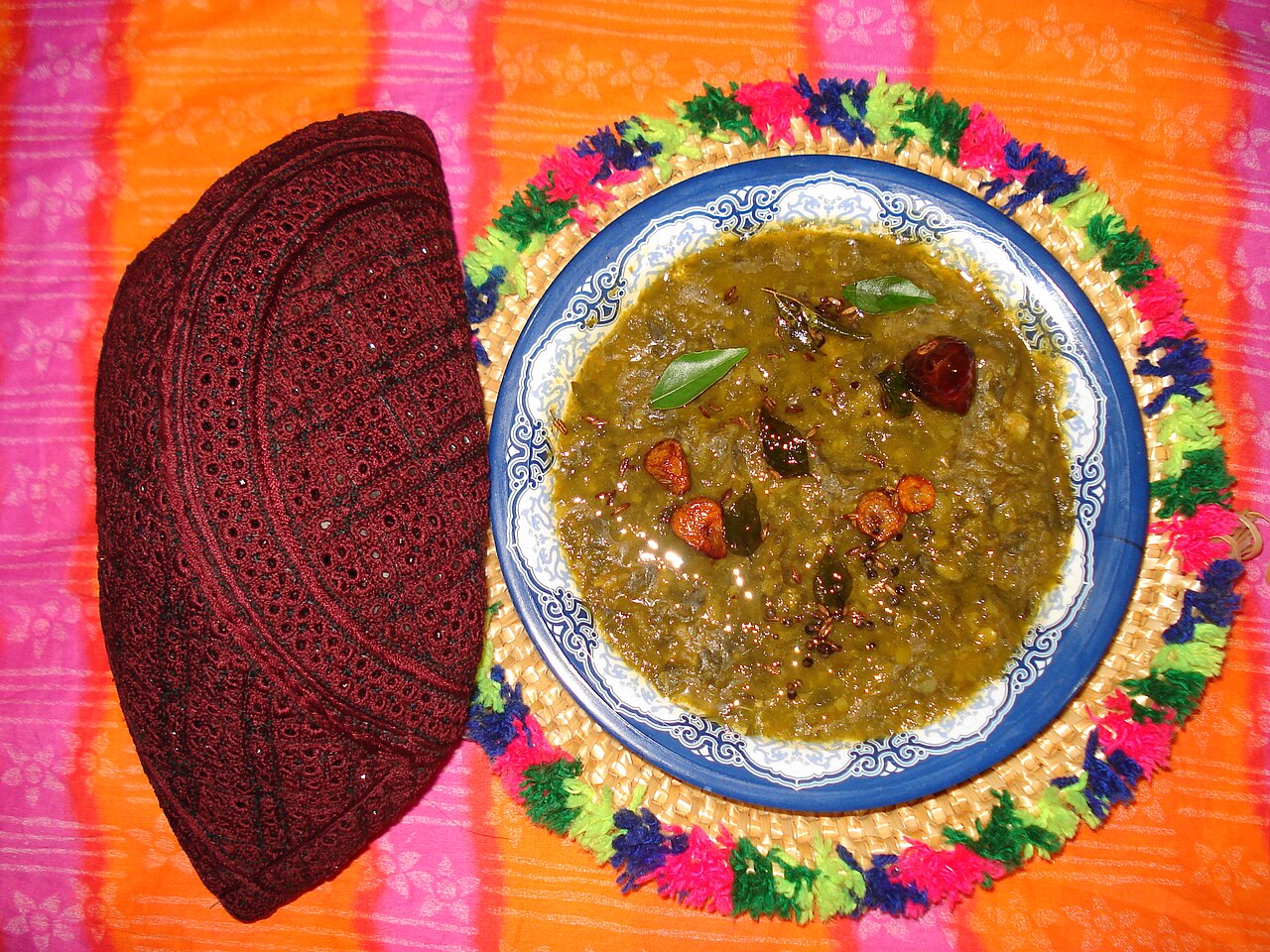
Sai Bhaji
spinach and chana dal cooked down with vegetables into a soft green mash, eaten with rice most weeknights
Allergens in Sai Bhaji: none of the ten listed below.
Ingredients
Quantities for 4.
- 500g, washed and roughly chopped Spinach
- 1 small bunch (about 50g), chopped Dillthe herb that makes it Sindhi rather than generic palak
- 1/3 cup (70g) Chana Dal
- 1 large, cubed Potato
- 1 small, cubed Eggplantoptional
- 1, diced Carrotoptional
- 2, chopped Tomato
- 1 large, chopped Onion
- 6 cloves, crushed Garlic
- 2cm piece, grated Ginger
- 3, chopped Green Chilli
- 1/2 tsp Turmeric
- 1 tsp Coriander Powder
- 3/4 tsp Chilli Powder
- 1 tsp Cumin Seeds
- 3 tbsp Neutral Oil
- 1.5 cups Water
- to taste Salt
Cookware
pressure cooker, stovetop
Checked against the ingredient list for ten allergens: milk, egg, fish, crustaceans, tree nuts, peanuts, sesame, mustard, soy and gluten. Brands vary, so read the label on anything new to you.
Before you start
- Rinse the chana dal and soak it 30 minutes while you chop everything. Unsoaked dal will still be gritty when the spinach has gone to mush.
- Wash the spinach in three changes of water. Sindhi sai bhaji is mashed, so grit has nowhere to hide.
- Chop the vegetables small and roughly the same size; nothing here gets browned, it all cooks together.
Method
- Heat the oil in the pressure cooker and crackle the cumin seeds, about 20 seconds.
- Add the onion, garlic, ginger and green chilli and fry 4 minutes, until the onion is translucent. You are not browning it.
- Stir in the tomato, turmeric, coriander powder and chilli powder and cook 3 minutes until the oil beads at the edges.
- Add the drained chana dal, potato, eggplant and carrot and turn everything through the masala for a minute.
- Pile in the spinach and dill with the water and salt. It will look impossibly full; press it down and it collapses within a minute.Go light on the water. The spinach releases a great deal of its own and a watery sai bhaji cannot be rescued.
- Close the cooker and cook on high for 3 whistles, then lower the heat and give it 5 minutes more. Let the pressure drop on its own.
- Open up and mash everything against the side of the pot with the back of a ladle until it is coarse and green, not smooth.Mash by hand, never in a blender. Blended sai bhaji turns a flat, unpleasant khaki.
- Simmer uncovered 5-8 minutes, stirring, until it holds its shape on a spoon. Check the salt.If it looks loose, this is where you fix it. It should mound, not pour.
- Serve hot with steamed rice, a spoon of raw onion and a wedge of lemon.
Storage
Keeps 3 days refrigerated. It stiffens when cold; reheat in a pan with 2 tbsp water, stirring, rather than in the microwave where it dries at the edges.
Nutrition Good estimate
One serving of Sai Bhaji (426 g) is about 276 calories, or 65 calories per 100 g.
Medium protein: 10 g a serving, 15% of the calories
| Per serving426 g | Per 100 g | |
|---|---|---|
| Calories | 276 kcal | 65 kcal |
| Protein | 10.4 g | 2 g |
| Carbohydrate | 35.2 g | 8 g |
| of which sugars | 7.5 g | 2 g |
| Fibre | 8.9 g | 2 g |
| Fat | 12.6 g | 3 g |
| of which saturated | 1.3 g | 0 g |
| of which unsaturated | 10.2 g | 2 g |
Ingredients given to taste count as zero, so the real figures run a little higher. Estimated from raw ingredients using USDA FoodData Central.
More like this: Healthy Indian recipes · Vegan Indian recipes · Vegetarian Indian recipes · Gluten-free Indian recipes · Dairy-free Indian recipes · Sindhi recipes
Times, yields, allergens and nutrition are guidance. Use your own judgement on doneness and on storing. More in About.